Rule 40 and the depiction of athletes during the Olympic Games – How to safeguard the interests of athletes and sponsors?
The upcoming XXV Olympic Winter Games in Milan-Cortina 2026 are not only a time of sporting excitement and fulfilling dreams, but also a period of heightened activity in sports marketing. With the start of the “Olympic Silence,” the rules of the game are changing for both athletes and their sponsors. So what does the advertising landscape look like during the Games, and what exactly does Rule 40 of the Olympic Charter mean?
What is Rule 40?
Rule 40, or more specifically, the implementing regulations for Article 40 of the Olympic Charter, govern how Olympic participants and their sponsors may carry out marketing activities. Its goal is to balance protecting Olympic sponsors’ interests and athletes’ rights to monetize their own image. Most importantly, Rule 40 is meant to safeguard “Olympic assets,” such as the Olympic logo, symbols, mascots, and slogans.
Before 2019, there was a complete ban on athletes advertising their personal sponsors during the Games. Since the International Olympic Committee (IOC) introduced changes, the rules have become more flexible, but their implementation is left to the discretion of national Olympic committees. In Poland, the rules for the upcoming Games are regulated, among others, by the Polish Olympic Committee (PKOl) document named Information on the Use of Participants’ Images during the XXV Olympic Winter Games Milan-Cortina 2026.
Blackout Period
During the Games, there is a period of Olympic Silence, during which the use of athletes’ images is strictly regulated. For the Milan–Cortina 2026 Games, this period runs from January 30 to February 24, 2026.
During this time:
- Only Olympic sponsors, i.e., companies that have official partner status with the IOC, the Organising Committee of the Games, or the National Olympic Committee, may use the image of the athletes in the context of the Games and have the right to use Olympic goods (rings, logo, “Olympic”, etc.).
- Athletes can cooperate with non-Olympic sponsors with whom they have individual contracts, but they must comply with the rules of the Polish Olympic Committee (PKOl).
- Any advertising campaign by non-official sponsors must be approved by either the Polish Olympic Committee (for domestic activities) or the International Olympic Committee (for international activities). Non-Olympic sponsors are required to submit campaign plans no later than December 19, 2025.
- Advertisements for non-Olympic sponsors must be general advertising, i.e.:
- May not contain references to the Games, Olympic symbols, or national team uniform; the only permitted connection to the event may be the image of the competitor himself.
- The campaign must be launched at least 90 days before the Games and cannot be explicitly intensified during the Games.
- Unofficial sponsors cannot publish congratulatory messages for participants, as such messages are not considered general advertising due to their close connection with the Games.
Campaigns published by individual athletes
Athletes may post simple thank-you messages to their individual sponsors during the Games, provided that:
- do not suggest that the product contributed to the results at the Games,
- they do not recommend a given product or service,
- they do not use Olympic symbols, the location of the Games, or appear in representative costumes,
- are in line with the IOC and POC guidelines regarding sponsorship bans on products containing tobacco, prohibited substances, etc.
Examples of situations
The examples below are taken from Illustrative Guidance for Non-Olympic Partners, which contains a wide range of additional scenarios and best practices.
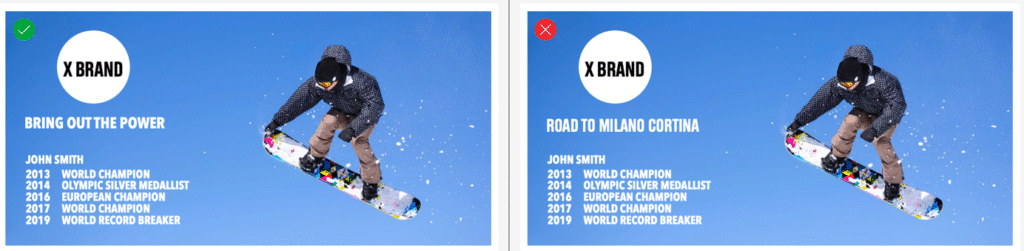
In the first case, the advertisement is general in nature and does not refer to the current Olympic Games in any way. The athlete does not appear in an Olympic uniform; the campaign was launched before October 29th, and his Olympic achievements are not highlighted more than other sporting successes. Such communication, provided all criteria are met, may be considered acceptable.
The second example shows an advertisement that is unacceptable because it contains direct references to the Winter Olympic Games in Milan, which violates the rules governing the use of an athlete’s image during the period around the Olympics.
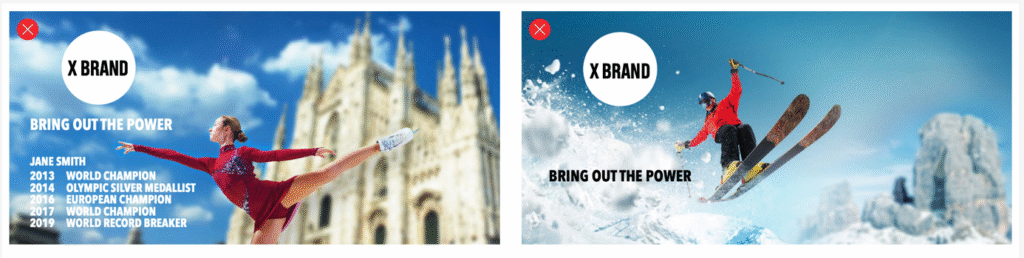
In the following scenario, both ads are banned because they reference recognizable symbols of Italian tourism, such as landmarks, city icons, and mountain landscapes. These elements could be seen as an unauthorized reference to the host country and therefore violate the principles outlined in Article 40.
Practical recommendations
To avoid Rule 40 violations and possible sanctions:
- It is worth including “Olympic” clauses in sponsorship agreements to regulate the silence period and compliance with IOC and PKOl regulations.
- Athletes taking part in the Games should be aware that their participation involves additional obligations regarding the use of their image.
- Non-Olympic sponsors should ensure their campaigns are generic and do not reference Olympic symbolism or suggest an official connection to the Games.
- Both athletes and sponsors should consult their actions with the Polish Olympic Committee or a sports law specialist.
Summary
Rule 40 is a key element in balancing the protection of Olympic values with athletes’ rights to exploit their image commercially. For athletes and sponsors, this means carefully planning promotional activities to ensure compliance with the rules while effectively building their brand.
Our law firm specializes in sports law and the drafting of sponsorship agreements. We help athletes, clubs, and sponsors navigate the regulatory landscape, from drafting Rule 40-compliant clauses to strategic advice on image and marketing rights. If you’re preparing for a sponsorship partnership ahead of Milan-Cortina 2026, we’re happy to help you handle every detail.
Sources:
- Polish Olympic Committee. ( n.d. ). Reguła 40 – karty olimpijskiej dla zawodnika. Retrieved November 14, 2025, from https://olimpijski.pl/teampl/regula-40-karty-olimpijskiej-dla-zawodnika/
- Sports Act of June 25, 2010, (Journal of Laws of 2010, No. 127, item 857).
- Polish Olympic Committee (PKOl). (2025). Informacje dotyczące wykorzystywania wizerunku uczestników podczas XXV Zimowych Igrzysk Olimpijskich Mediolan-Cortina 2026.
- Polish Olympic Committee (PKOl). (2025). Możliwości podejmowania działań o charakterze komercyjnym przez uczestników Igrzysk – przewodnik ilustrowany dla sponsorów nieolimpijskich.
Blog created by